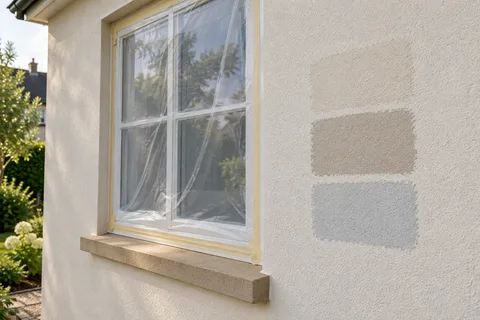
Render recolouring and coatings
Render respray and colour changes in Bradford
A respray changes the colour, or refreshes the surface, of existing render with a sprayed coating. The render stays where it is, so it has to be sound. In Bradford the most important rule is what not to spray: the council’s stone guide says do not paint stonework, so the coating goes on the render and the sandstone sills, heads and quoins stay bare.

On this page
When a respray is the right job
A respray suits render that is firmly bonded but faded, patchy after repairs, stained by algae or simply the wrong colour. It does not fix hollow, cracked or bulging render, which has to be repaired first. It is also a common way to tidy a commercial or mixed-use frontage where the upper floors are rendered and the shopfront below is a separate design.
Colour is a design decision as well as a maintenance one. On an Arts and Crafts or Old English house, the council’s render guide says the render was traditionally limewashed, giving its white colour, and treats white upper storeys as a key feature of those buildings. A bold colour on one house in a matched pair or a terrace can look out of place, so look along the street before choosing.
- Clean Washed down, with algae and mould treated and left to work.
- Repair first Cracks and hollow patches are repaired before any coating.
- Prime or stabilise Where the coating maker requires it on that surface.
- Coating Usually two coats of a breathable masonry or silicone coating.
The usual order of work. The survey and the chosen products decide the actual steps.
Choosing a coating that suits the render
The coating must match the render beneath it. Bradford Council’s render guide recommends limewash or oil paint on historic lime render because they let the render breathe, and warns that modern impermeable or long-life paints can damage the render and potentially the wall behind it. It also says to use the same coating when repainting, because not all coatings are compatible with each other. On modern cement or through-coloured render a breathable masonry coating is used; K Rend, for example, makes a silicone masonry paint, and a separate product, Colour Enhance, for refreshing existing scraped render.
Find out what is on the wall now before choosing. A previous coat of a dense masonry paint, an old limewash and a bare through-coloured render each need a different approach.
The process
The wall is tapped and any hollow areas repaired and left to cure. Everything not being coated is masked: windows, doors, stone dressings, signs, roofs and paving. The render is cleaned, given a biocide against algae, rinsed and left to dry. Powdery or patched areas are primed or stabilised. The coating is sprayed in even passes, usually two coats, with edges cut in by brush.
Tap-test; repair hollow or cracked areas and let them cure.
Mask stone sills, heads, quoins, glazing, signs and paving.
Wash, treat with biocide, rinse and dry the render.
Prime or stabilise patched and powdery areas.
Spray the coating in even passes; cut in edges by brush.
Apply the second coat; unmask and check the stone is clean.
Stone, shopfronts and neighbours
Overspray on sandstone is hard to remove without harming it, and the council discourages stone cleaning in most situations, so the masking has to be thorough. Spraying stops in wind that would carry drift onto neighbouring property or parked cars. On a mixed-use building, agree with the occupiers exactly which surfaces are included: the rendered upper floors, the side return and any render panels around the shop sign. Before changing the colour of a building in one of the district’s 60 conservation areas, check with the council whether permission is needed.
After the respray
Because the Planning Portal leaves decorative finishes out of its definition of renovation, recolouring render does not bring in the insulation requirements that a full re-render of a large area can. Keep a note of the product and colour so touch-ups and the next recoat use the same system. Wash off green growth gently with a biocide, and repair chips before water gets in behind the coating.
Common questions
Can I spray the stone surrounds to match the render?
Bradford Council’s stone guidance says not to paint stonework: paint can trap water and damage the stone, and in conservation areas it harms the character of the street. Keep the surrounds bare.
Will a respray hide the patches from earlier repairs?
Usually, once the patches have cured and are primed so they take the coating evenly. Texture differences between old and new render may still show in low sunlight.
How long does a respray last?
That depends on the coating, the exposure and how well the render was prepared. Keep gutters and sills in repair, wash off algae when it appears and touch up damage early; walls that stay dry hold their colour longest.
See housing and planning information for Bradford and nearby places, including the source and geography behind each figure.