Removing pebbledash
Pebbledash removal in Bradford
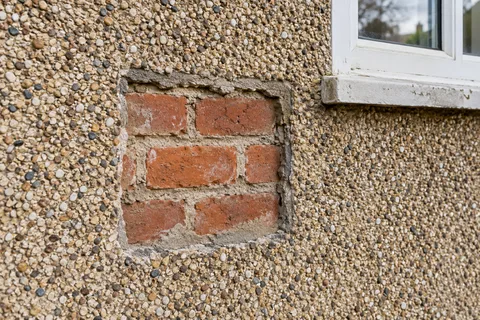
In pebbledash, small stones are thrown at the render while it is wet; in roughcast they are mixed into it. Removal means hacking the coating off, repairing what is beneath and choosing a new finish. In Bradford there are two very different cases: dash put over stone or brick at a later date, and dash that is an original feature of an early 20th-century house.

On this page
When the dash is original
Bradford Council’s render guide notes that render with pebbles or small stones mixed in, variously called pebbledash, roughcast, wet-dash, dry-dash or harling, is a traditional finish on Old English and Arts and Crafts houses, usually on the upper storey over stonework. It treats that render as a key feature of these buildings and advises against removing render altogether where it is original. On such a house, repairing and recoating the dash is the conservation answer, not stripping it.
- Trial area A small patch is taken off to see how well the dash is bonded and what lies beneath.
- Removal Dash and backing render are hacked off to masonry or to a sound backing coat.
- Clear and dispose Debris is bagged or skipped; this is heavy, dusty and noisy work.
- Repair the masonry Exposed bricks, blocks and joints are repaired before anything new goes on.
- New render system The wall is rendered with the chosen system, or left as fair-faced masonry if suitable.
The usual order of work. The survey and the chosen products decide the actual steps.
When the dash was added later
Where traditionally bare stonework has been painted over or rendered, the council’s stone guide says it would be appropriate to clean off those coverings, using an experienced professional who will not damage the stone or mortar, and suggests contacting its Conservation Team for advice because company brochures can be misleading. For example, on a stone terrace where one front has been dashed, removing the dash can return the house to the bare stone of its neighbours.
How it is taken off
Removal is done by hand. SPAB recommends hand tools, a small test area first and no prising off of big slabs, which can tear the face from soft stone. On sandstone the trial tells you whether the dash comes away cleanly or takes the stone face with it; if it takes the face, a different plan is needed. Windows are boarded, the ground sheeted and the waste bagged as it comes down.
Expect noise, dust and a skip or bags of rubble for every elevation. Hacking off is slower around window heads, sills and door surrounds, where the dash is cut back carefully so the stone or brick edges are not chipped. It is usually done from scaffold rather than ladders, because the whole face has to be reached and the waste lowered safely.
Establish whether the dash is original or a later addition.
Remove a small trial area by hand and inspect what is behind.
Protect windows, doors, paths and neighbouring houses.
Hack off the dash working down from the top.
Brush down, rake out joints and assess damaged stones.
Repoint stone in a soft mortar, or prepare brick for re-rendering.
What you might find, and what comes next
Under the dash there may be sound stone, but also stones with damaged faces, cement-filled joints, patched-in brick around altered windows or traces of old paint. Where the stone will stay bare, the council’s guide sets out the repair: rake out defective joints by hand to 25 to 40 mm and repoint in six parts sand to one of cement and one of lime, flush or slightly recessed, and replace only stones that are deeply eroded or fractured, using stone from the same or a similar local source and of the same size and dressing. Brick that was never meant to be seen is re-rendered.
Paint or cement left on the stone after removal needs specialist cleaning; the council warns that cleaning done incorrectly can cause irreversible damage.
Overcoating instead
Sound dash that you dislike can be overcoated rather than removed. K Rend’s overcoating dash receiver, for example, is designed to be applied straight over old dry dash, without a base coat, to take fresh dash; alternatively a masonry paint will give a new colour. Neither option suits a wall of traditionally bare stone that has been dashed, where the aim should be to take the covering off, not add another layer.
Common questions
Will the stone underneath look like my neighbours’ walls?
Not straight away. It may carry cement residue or paint, and stone that has been covered has not weathered with the rest of the street. The council discourages cleaning stone generally, so expect it to settle in over time rather than be cleaned to match.
Do I need permission to remove pebbledash?
Removing a later dash from traditionally bare stone is the kind of work the council’s guidance supports, but ask its Conservation Team first, especially on a listed building. Removing original dash from an Arts and Crafts house, or replacing it with a different finish in a conservation area, is more likely to need permission.
See housing and planning information for Bradford and nearby places, including the source and geography behind each figure.