Silicone render systems
Silicone rendering in Bradford
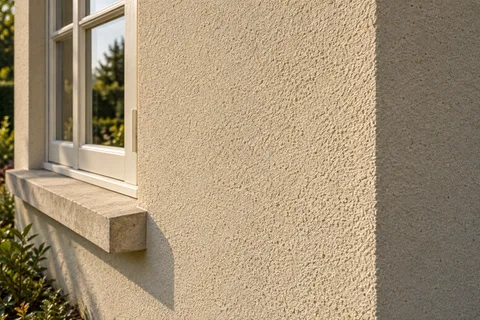
Silicone render is a ready-to-use resin finish applied only as thick as its grain, over a base coat and primer. It repels rain at the surface, lets vapour pass and resists algae, which is why it is used on new-build blockwork, extensions and external wall insulation. In Bradford it often goes onto a brick or block wall that sits next to stone, so the edges matter as much as the finish.

On this page
From the wall outward
K Rend’s Silicone TC system is a typical example. The wall is prepared and given a base coat, with mesh where the specification calls for it, and the base coat is given a fortnight or more to cure before anything goes over it, as the data sheet requires. Primer TC, tinted to the finish colour, goes on and is given 24 hours to dry. Silicone TC then goes on no thicker than its biggest grain (TC15 has 1.5 mm grains, TC30 has 3 mm) and is rubbed up with a plastic float to form the texture.
A topcoat that thin follows every dip in the layer beneath, so a careful applicator spends the time getting the base coat straight.
- Sound background A background accepted by the specified system. Keeping old render requires a system-specific assessment of its bond and condition.
- Beads Corner, stop and base beads set the edges and straight lines.
- Basecoat with mesh Glass-fibre mesh embedded in the basecoat resists cracking.
- Primer Where the system requires it, tinted towards the finish colour.
- Silicone finish A thin, through-coloured, water-repellent coat that forms the texture.
Wall on the left, finish on the right. Not to scale: coats, thicknesses and primers follow the chosen manufacturer’s system and the condition of the wall.
Good uses and poor ones in Bradford
Silicone suits block and brick extensions, new houses, concrete, render boards and insulation systems, and it can go over sound existing render after cleaning and a base coat. It is not for bare sandstone. Bradford Council’s stone guide says not to render stonework, and separately warns never to apply any sealant or silicone water repellent to stone, because it could trap moisture in the wall. That warning concerns clear treatments brushed onto stone, not silicone render on block, but both point the same way: keep silicone products off traditionally bare stone.
It is also a poor match for an Arts and Crafts upper storey over stone, where the council recommends soft lime render.
Application, day by day
Each wall face is finished without a break, working to a wet edge, so the size of the crew is matched to the size of the wall. Long rear elevations of terraces or blocks of flats are split at corners, downpipes and beads. The data sheet sets a minimum of 5°C for air and wall, no work in strong sun or wind, no damp or frozen backgrounds, and protection from rain and from drying too fast, so scaffolds are usually sheeted.
Repair the wall and remove loose material.
Fix beads at the DPC, corners, openings and against stone.
Apply the base coat, embed mesh and rule it flat.
Leave the base coat to cure.
Apply colour-matched primer and leave it 24 hours.
Float on the topcoat and rub up the grain, one continuous pass per wall.
Where silicone meets stone
Many Bradford extensions are block-built against a stone house. The silicone render stops on a stop bead at the stone corner or reveal and never laps onto the stone face. Stone sills and copings set into the rendered wall are masked throughout. The colour beside sandstone needs judging on site: a sample board held against dark, uncleaned stone reads very differently from the same colour on a chart, and a bright white can look stark beside it.
Cleaning and repairs
Silicone stays cleaner than paint, and K Rend’s product contains a biocide to help prevent moulds, yeasts and algae, but shaded walls will still green over time. Wash with a soft brush and a render cleaner; high-pressure jets can strip the grain. Repairs are made by cutting back to a joint or corner and re-applying the topcoat, so keep the colour reference and grain size. Recoating later should use a coating compatible with silicone render.
Common questions
Is silicone render the same as a silicone sealer?
No. Silicone render is a coloured resin finish on a base coat. A clear silicone water repellent is a liquid brushed onto masonry, and Bradford Council’s stone guidance says never to apply one to stonework because it could trap moisture.
How long before silicone render can go on a new block extension?
The blockwork must be dry and the base coat cured. K Rend wants the base coat left for two weeks or more before priming, and none of it should go on in frost, rain or strong sun.
See housing and planning information for Bradford and nearby places, including the source and geography behind each figure.