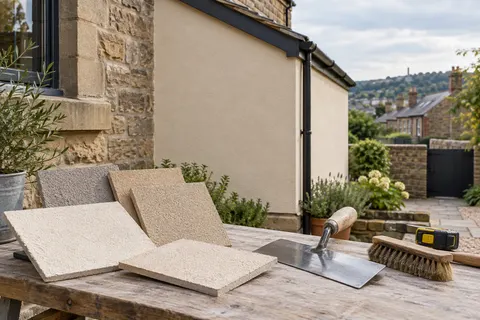
Rendering one elevation
Wall rendering in Bradford
Wall rendering means treating a single elevation: an end gable, the rear wall of a terrace, an outrigger or an extension. In Bradford that wall often sits beside sandstone, either on the same house or on the house next door. Two questions therefore come before any render goes on: should this wall be rendered at all, and how will the new render meet the stone that stays?

On this page
When a stone wall should not be rendered
Bradford Council’s stone elevations guide is explicit: do not paint or render stonework, because the district’s stone buildings are traditionally bare and covering them breaks the visual unity of streets and terraces. It also gives the physical reason. Render and paint can damage stone by trapping water and causing damp, or making existing damp worse, and moisture trapped behind hard renders appears in its list of causes of decay. A weathered sandstone gable is normally a case for repointing and, where needed, replacing badly eroded stones, not for a coat of render.
The guide’s pointing advice shows the alternative. Rake out defective joints by hand to between 25 and 40 mm, repoint with six parts sand to one part cement and one part lime so the mortar stays softer than the stone, and finish it flush or slightly recessed. That deals with the commonest reason a stone wall lets water in.
- Set the edges Decide where new render stops against brick, stone or an existing finish.
- Prepare the background Remove loose material, repair masonry and prepare suction and surface key. Existing paint needs a specified removal or alternative treatment.
- Base coat Built up to level the wall, with mesh where backgrounds change or crack.
- Finish Matched to the rest of the house or chosen as a deliberate contrast.
- Shed the water Copings, sills and the base bead keep rain off the top and away from the bottom edge.
The usual order of work. The survey and the chosen products decide the actual steps.
Walls where render is the right answer
Render belongs on walls built to be rendered or that cannot sensibly be left bare: brick or block extensions, a gable exposed when the neighbouring building came down, walls of common brick or mixed patching, and the rendered upper storeys of Arts and Crafts houses. On those, a single-wall job follows the same sequence as a whole house, with extra care where it ends.
An exposed party gable is a good example. When the building next door is demolished, the wall left behind was often built of rough common brick or roughly dressed stone that was never meant to face the weather. It may have holes where floor joists and chimney breasts were tied in. Render, over a properly repaired and filled wall, is a reasonable way to weatherproof it; the council’s stone guidance is concerned with traditionally bare stone elevations, not with an internal wall that has become external.
How a single wall is done
Any old render is cut to a clean line where the new work will stop, and the rest is hacked off. The exposed wall is brushed down, repointed and repaired; new blockwork is left to dry. Beads are fixed: angle beads on external corners, stop beads against stone or retained render, and a bell-cast bead set a little above the DPC. The base coat goes on with mesh bedded around windows and doors, where cracks tend to start, then the finish coat.
Decide whether the wall should be rendered or repaired as stone.
Cut old render to a clean stopping line and strip the rest.
Repair and repoint the wall; let new blockwork dry out.
Fix angle, stop and bell-cast beads.
Apply the base coat, bedding mesh at openings.
Apply the finish, then protect it while it cures.
Where render meets stone
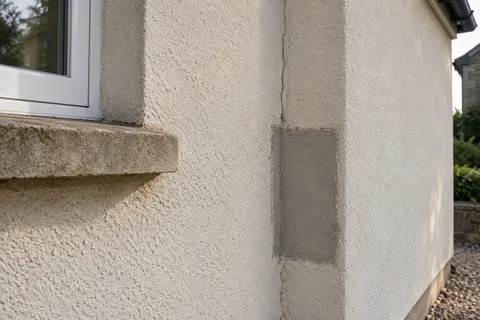
The junction between new render and sandstone is the detail everyone sees. The render should stop on a straight stop bead set to the edge of the stone, so it never laps over the face. Quoins, sills and kneelers are masked while the render goes on and any splashes cleaned off the same day; dried cement on sandstone is hard to shift, and the council discourages stone cleaning in most situations because done incorrectly it can damage the stone. On an end-terrace where the gable is rendered and the front stays stone, the corner is the natural stopping point.
If the gable adjoins a neighbour’s stone wall, agree the line before work starts and keep render and spray off their property.
Matching and protecting the wall
A single new wall will look fresher than the house around it. Painted finishes can be matched by painting the whole elevation; through-coloured render settles in with time but rarely matches older work exactly. Protect the new render from rain and frost while it cures, and from strong sun on south and west faces.
Common questions
Can I render one gable of a stone terrace?
In a conservation area the council’s guidance is against rendering traditionally bare stone, and render cladding there falls outside permitted development. Outside one, the physical risk of trapping water in the stone still applies. Repairing and repointing the stone is usually the better route.
Can I paint a stone gable instead of rendering it?
The council’s stone guide treats paint the same way as render: it advises against painting stonework because paint can trap water and damage the stone, and it says existing paint should be carefully removed. Repointing is the usual repair.
See housing and planning information for Bradford and nearby places, including the source and geography behind each figure.