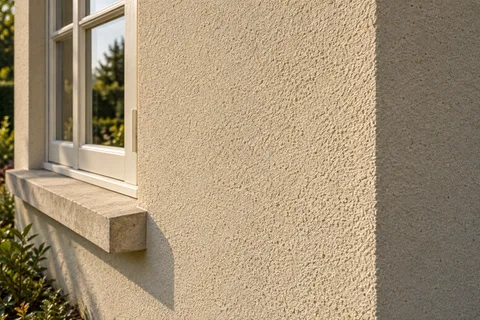
Monocouche finishes
Monocouche rendering in Bradford
Monocouche is a cement-based render coloured right through, sprayed onto the wall in one thick pass and scraped to a texture once it begins to set. It is quick on large areas of blockwork, which is why it is common on new-build housing and commercial units. It needs a suitable, consistent background and careful timing; it is not a finish for stone or for the soft walls of an older building.

On this page
How thick, and why scraping matters
The K Mono data sheet is a useful reference point. The render is sprayed through a 12 or 14 mm nozzle to 17 to 18 mm, levelled straight away and scraped once it has semi-set, anywhere from 3 to 24 hours later depending on the background and the weather. The finished thickness after scraping should be at least 15 mm. Scraping in a tight circular motion takes off the surface skin and exposes some of the aggregate, and the wall is then brushed down with a soft brush.
Through-coloured means a scuff or small chip shows the same colour underneath, and the wall does not need painting to look finished.
- Background Usually blockwork or brick; uneven or mixed walls may need a levelling coat.
- Beads and mesh Beads at corners, reveals and the base; mesh over junctions and lintels.
- Monocouche passes One through-coloured material, applied in passes to the specified thickness.
- Scraped surface Scraped once partly set, which removes the skin and leaves the texture.
Wall on the left, finish on the right. Not to scale: coats, thicknesses and primers follow the chosen manufacturer’s system and the condition of the wall.
Which Bradford walls it suits
K Rend says K Mono can finish most blockwork of moderate or low strength in a single coat. New estates, blockwork extensions to terraces, flats and industrial units are its natural ground. Older brick may need a base coat first, depending on the manufacturer’s guidance for that background. It does not belong on traditionally bare sandstone, which Bradford Council advises should not be rendered, or on Arts and Crafts upper storeys, where the council recommends soft lime render.
Spraying and scraping a big wall
The main risk on a large elevation is uneven colour. The data sheet warns that all areas must be scraped at the same stage of readiness: early scraping gives darker shades and late scraping lighter ones. A long wall is therefore split into bays at corners, beads or designed joints, and each bay is sprayed and scraped as one, instead of stopping mid-wall when the day ends. The surface is ready when a thumb leaves no impression and the aggregate scrapes off cleanly without sticking to the scraper.
Where a joint between bays cannot be hidden at a corner or a downpipe, a designed joint or an ashlar-style groove gives the line a purpose. An unplanned day joint across a plain wall shows as a faint band of different shading for as long as the render lasts.
Check the blockwork is sound, clean and suitable for the product.
Bead the base, corners and stop ends; sheet over glazing and doors.
Spray to thickness and rule flat with a straight edge.
Wait for semi-set and test with thumb pressure.
Scrape the whole bay evenly, then brush it down.
Protect the bay from rain, frost and direct sun.
Weather, edges and faults
The data sheet says K Mono should not be applied below 5°C or above 30°C, if frost is forecast within 24 hours, in damp or wet conditions, or on elevations in direct sunlight, and the wall itself should be between 3°C and 30°C. Most faults trace back to those limits or to the edges: patchy shading from uneven scraping, cracks from window corners, and staining where render runs below the DPC rather than finishing on a bell-cast bead. The data sheet allows quoins, reveals and other small areas to be left smooth, which gives a crisp line at each opening.
Upkeep and colour changes
Brush off loose dirt and treat algae with a biocidal wash rather than a pressure washer. Patches can be made in the same product but will look fresher until they weather. K Rend sells Colour Enhance as a coating for tired scraped render; once it is coated, the wall needs recoating periodically like any painted wall. Keep the product, colour and texture details in the building file for future repairs.
Common questions
How long does monocouche take to finish?
The scraping window depends on the wall and the weather; K Rend gives 3 to 24 hours for K Mono. Large walls are sprayed in bays so each can be scraped at the right moment.
Can monocouche be ashlar-cut to look like stone?
The data sheet permits ashlar grooves once the wall is scraped, as long as 15 mm or more of coloured render remains behind every groove. Beside real Bradford sandstone, imitation joints can look out of place, so try a sample first.
See housing and planning information for Bradford and nearby places, including the source and geography behind each figure.