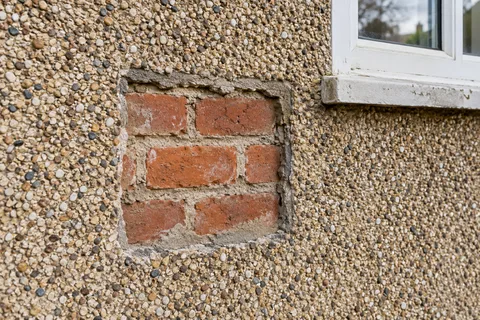
Lime render and older masonry
Lime rendering in Bradford
Lime render is a soft, permeable render made with lime instead of cement. Bradford Council’s homeowner guide recommends traditional soft lime-based render for historic rendered buildings, applied in three coats and finished with limewash or oil paint. It is the right material for Arts and Crafts and Old English upper storeys, older rendered cottages, and for replacing failed cement render on old stone or brick.

On this page
What the council’s render guide says
The guide explains why lime suits these walls: it is permeable, absorbs rainwater and dries out naturally, and because it is soft it allows movement in the wall, such as expansion in warm summer weather, without being damaged. Hard cement render does the opposite. It is impermeable and harder than the stone behind it, so water that gets in is trapped and causes decay and damp; it is also inflexible and cracks in cold or warm weather, letting more water in. The guide also warns against modern impermeable or long-life paints on render, because they stop it breathing.
It adds that render should not be removed altogether where it is an original feature, and that it should be smooth or rough to suit the architectural style, with other buildings in the area or historic photographs as a guide.
- Stone or brick masonry Cleaned of loose material and dampened so it does not draw water out too fast.
- First (scratch) coat Often haired; scratched to give the next coat a key.
- Second (floating) coat Applied once the first has firmed up; follows the line of the wall.
- Finish coat Thin final coat, kept damp and shaded while it cures.
- Limewash or mineral paint Optional decoration that keeps the wall permeable.
Wall on the left, finish on the right. Not to scale: coats, thicknesses and primers follow the chosen manufacturer’s system and the condition of the wall.
Preparing the wall
Failed cement render is taken off by hand, as SPAB advises, testing a patch first and avoiding levering off big sheets that can tear the face off the stone. Joints are raked and repointed, decayed stones made good, and a saturated wall given time to dry. Dense stone or hard brick may need a stipple bond coat to give the lime something to grip; K Rend’s K Lime SB1 is one example, scrubbed into the surface and left with a rough stipple. Just before each coat the wall is dampened, so it does not draw the water out of the fresh lime too fast.
Three coats, built up by hand
The first coat is thrown or trowelled on, roughly levelled and scratched to key the next. When it has firmed, the second coat straightens the wall and is keyed in turn. The third, thinner coat is finished with a wood float for an open texture, worked smoother where the style calls for it, or dashed for a roughcast; K Rend’s K Lime Roughcast, for example, mixes two parts roughcast to one part 4 to 8 mm limestone chips. Each coat goes on only when the one beneath has set enough, which takes longer than with cement.
Take a trial patch, then strip failed or cement render by hand.
Repoint and repair the stone; let a wet wall dry out.
Apply a stipple or bond coat to dense backgrounds.
Dampen the wall, then apply and scratch the first coat.
Apply and key the second coat once the first has firmed.
Apply and finish the third coat to suit the building.
Cure under damp hessian; finish with limewash or oil paint.
Curing and weather
Lime must not dry too fast or freeze. Cornish Lime’s guide says hessian draped over the work should stay for at least two weeks, and that drying too quickly inhibits the hydration and carbonation that harden the lime. Frost on lime that has not set is the other risk, so most lime rendering is done between spring and autumn. The same guide says cracks from plastic shrinkage appear inside 48 hours, with drying shrinkage to follow if wind, high temperatures or strong sunlight dry the render too fast.
Scaffold sheeted with hessian, and someone visiting each day to mist it, is part of the job, not an extra.
Finishing and maintenance
The council recommends limewash or oil paint because both let the render breathe, and says to use the same coating when repainting, because not all coatings are compatible with each other. Limewash weathers and is renewed in thin coats. Tap the render every few years: the council’s guide says hollow areas may be loose and can be patched, and warns not to ignore them, because cracked render lets water into the stone and frost forming behind loose render can force it off the wall.
Common questions
Can I use cement to patch lime render?
Avoid it. A cement patch is harder and less permeable than the lime around it, so it cracks at the edges and holds water. Patch lime render with lime of a similar strength and texture, and limewash over the repair.
See housing and planning information for Bradford and nearby places, including the source and geography behind each figure.