Practical rendering advice
Should you render a stone-faced house in Bradford?
Owners of Bradford stone houses often consider render to stop damp, hide stained stone or tidy mismatched repairs. Bradford Council’s guidance is that traditionally bare stone should stay bare, and the reasons are physical as well as visual. This guide explains what render does to a stone wall, what usually fixes the problems people hope render will solve, and where render on stone is legitimate.

On this page
What covering stone would change
Rendering replaces the visible pattern of stones and mortar joints with a continuous surface. That changes more than the colour. A window surround that stood out from the walling looks shallower once the wall face around it is built up, and a band between storeys can be lost altogether. A terrace whose fronts all show the same weathered sandstone reads as one group until one house is rendered.
Bradford Council’s stone guide explains how the stone was worked. Walling stones were split into roughly dressed ‘bricks’ with a hammer, the surrounds to windows and doors were given a smoother finish, and the stone for wealthier houses was finely tooled or dressed to a smooth ashlar by hand. Render hides all of that. The guide advises against painting or rendering such stonework, and the council’s render guide limits traditional render to particular later styles.
Where a house is part stone and part render, the two are treated separately. An existing rendered extension can be repaired or recoated without touching the stone front, and a house rendering job on a brick rear wing does not need to extend to the stone elevations.

What the council’s stone guidance says, and why
Bradford Council’s homeowner guide to stone elevations makes three points that matter for rendering. First, the district’s stone buildings are traditionally bare: it notes that all stonework, including the window reveals, was traditionally left uncovered, which gives terraces and streets their unity. Second, paint and render can damage stone by trapping water and causing damp, or making existing damp worse. Third, it lists moisture trapped behind hard renders among the sources of damp and decay, alongside failed rainwater goods, blocked gullies and open joints.
The same guide explains how a stone wall is meant to handle water. Pointing is not there to hold the stones together but to help keep them dry, absorbing moisture and letting it evaporate, and it is meant to be softer than the stone. That is why it recommends a mortar of six parts sand to one part cement and one part lime, and warns that cement-rich mortar sets harder than the stone, traps moisture and makes the stone weather faster. A hard render over the whole face works the same way on a larger scale.
| Question | Evidence to seek |
|---|---|
| Why change the surface? | A clear aim separate from untested diagnosis. |
| What was intended originally? | Photographs, records and competent assessment. |
| What is defective? | A condition-based repair recommendation. |
| What controls apply? | Address-specific designation and advice. |
If the problem is how the stone looks
Dark, almost black sandstone is normal in Bradford. The council’s stone guide explains that local sandstone ranges from creamy to golden when quarried but darkens with exposure to smoke, and that iron in the stone can leave orange-red stains. It treats darkened stone as a sign of age and of the region’s industrial history, and discourages cleaning because it removes that patina, can damage the stone and makes one house stand out from its neighbours.
Pointing is the other common complaint. Strap or ribbon pointing that stands proud of the stone, or grey cement mortar, looks heavy and harms the stone. The guide’s answer is to rake it out once it can be removed without damage and repoint flush or slightly recessed in a sandy-coloured mortar, brushed to expose the aggregate. That changes the look of a wall more than most owners expect.
If the mismatch is between a stone house and a rendered extension, recolouring or re-rendering the extension is the usual fix, and the stone stays as it is.
If the problem is dampness or decay
Find where the water is coming from before choosing any treatment. The stone guide’s list is a good starting point: rainwater goods that leak or overflow, drains and gullies at ground level that are blocked, cracks or open joints in the wall, burst plumbing, and water trapped behind hard renders. Traffic splashing rainwater against a wall is another, and the guide warns that simply covering stones damaged that way will not solve the problem and will make it worse.
Most of those are repairs, not rendering. Defective pointing is raked out by hand to between 25 and 40 mm and repointed flush or slightly recessed in a soft mortar. Stones that are deeply eroded or fractured are replaced, or turned round if sound, using stone from the same or a similar local source. The guide also says never to apply a sealant or silicone water repellent to stonework, because it can trap moisture in the wall.
If inside walls are damp, record where and when, and look at the outside of the same wall for the sources above. Render is not a waterproofing treatment for a stone wall, and damp with causes other than the walls is a matter for a different specialist.
Where render on stone is legitimate
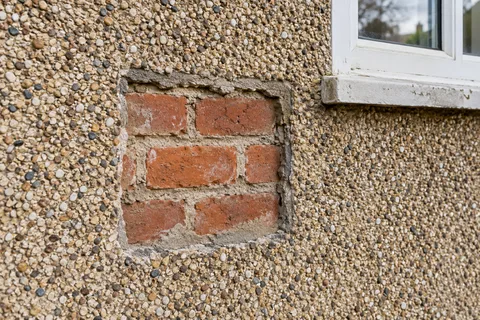
The council’s render guide identifies the stone buildings where render is traditional: late 19th and early 20th century houses in the Old English and Arts and Crafts styles, where usually the upper storey was rendered over the stonework, sometimes within mock timber framing, and limewashed white or finished as pebbledash or roughcast. On those, render is a key feature and the guide advises against removing it. Repairs use soft lime-based render in three coats.
Beyond that, a stone wall that was never meant to face the weather is a different case: a party gable exposed by demolition, or rubble walling built to be hidden. There, a lime render over a repaired wall can be a reasonable way to protect it. Where a coating is already present, a carefully specified test can show whether removal or overcoating makes more sense.
If the stone has already been rendered or painted
Many stone houses were painted or rendered in the past. The council’s stone guide says that where traditionally bare stonework has been painted over or rendered, it would be appropriate to clean off those coverings, provided an experienced professional does the work without damaging the stone or mortar. It recommends contacting the Conservation Team for advice, because company brochures can be misleading. Removal starts with a small trial, because a hard render or paint can pull the face off soft sandstone, and the method follows what the trial shows.
Deciding
For a traditionally bare stone house, the answer is nearly always to repair the stone rather than render it: fix the water sources, repoint where the mortar has failed and replace badly eroded stones. Render becomes the answer where it was part of the design, on an Arts and Crafts upper storey for example, or on a wall never meant to be seen. If a later render or paint is already on the stone, removing it is often better than renewing it.
The Bradford rendering homepage links to the repair, lime and removal pages, which explain each of those jobs in more detail.
See housing and planning information for Bradford and nearby places, including the source and geography behind each figure.