Practical rendering advice
Choosing render for a large, uninterrupted wall
On a large, plain wall, every small difference in texture, flatness and colour shows. The choice between silicone and monocouche, the flatness of the base, the way the wall is divided into bays and the light falling on it all decide how the finished elevation looks.

On this page
Colour, texture and flatness are three separate choices
A colour card answers a fairly narrow question about shade. It does not show the depth of the grain or whether the existing wall has a shallow hollow. On a large elevation, those three characteristics combine in the view from the street. Changing one does not necessarily change the others. A new colour may leave the outline of the old surface irregularity just as visible.
Texture describes the small-scale pattern of the finish; flatness concerns the larger plane of the wall. A deliberately textured finish can be applied over a well-prepared plane, while a fine finish can reveal undulations beneath it. When discussing the result, describe the feature you mean. A request for smooth render could otherwise be interpreted as a finer grain when the owner actually expects a straighter wall.
Flatness is set before the finish goes on. A thin silicone topcoat follows the base coat beneath it, so the base coat has to be ruled straight; a monocouche is levelled with a straight edge as soon as it is sprayed, before it sets. Hollows deeper than the render can take are dubbed out in an earlier coat.


Similar colours can come from different systems
Silicone render and a monocouche proposal can both offer a coloured exterior, but the names do not describe interchangeable layers. Weber distinguishes a silicone thin-coat finish from monocouche render. For a specific product example, K Rend describes K Mono as a coloured monocouche with a scraped or roughcast finish. Its instructions include application followed by a separate scraping stage for the scraped texture.
The practical difference is in the layers. Silicone means a meshed base coat left to cure, then primer, then a topcoat no thicker than its grain. A monocouche is one thick through-coloured coat, sprayed and then scraped. The silicone gives a finer, more water-repellent surface; the monocouche is quicker on suitable blockwork.
On a broad wall with few windows there is nothing to break up the surface, so variations in shading, joins between bays and undulations in the base all show. Those are what the rest of this guide deals with.
| Question | Evidence to request |
|---|---|
| How is the background prepared? | A description of assessed condition and treatment. |
| How will texture look? | A suitably positioned sample. |
| Where does work stop? | An agreed layout respecting joints and boundaries. |
| How are details handled? | Drawings or notes for openings and edges. |
Where the wall is seen from
A large wall is usually seen at an angle as much as straight on: along a yard, from a road approaching the building or from a car park. At a shallow angle, texture and unevenness are exaggerated, and joints between bays line up into visible stripes.
Orientation matters too. A west-facing wall in evening sun shows every hollow; a north-facing wall in flat light hides them but greens faster.
If another building is the reference, note what you like about it: its colour, its grain, the absence of visible joints or the way the render meets the windows. Those are different properties, and some depend on the wall behind as much as the finish.
Sample panels for a big wall
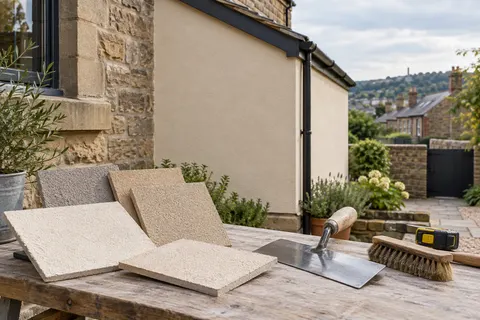
A colour chip narrows the choice; it does not decide it. For a large elevation, a panel in the actual product, texture and colour, applied by the crew that will do the wall, shows how the finish reads. K Rend advises a site sample panel for K Mono, noting that shades can vary slightly because the materials are natural.
Judge the panel once it has dried, in the light the wall will get and from the distance it will be seen. Keep it on site so the finished wall can be compared with it.
A panel shows the finish, not the state of the wall behind. If the background needs more preparation to achieve the look in the panel, that is decided before the wall is started.
How a large wall is applied
A large face is split into bays that can each be finished in one go. The bays end at corners, downpipes, beads or designed joints, because both main finishes punish an unplanned stop. With silicone, each surface is carried through to a wet edge with no stopping. With monocouche, the whole bay is scraped at one stage of set, or early-scraped areas come out darker and late ones lighter, as K Rend’s K Mono data sheet warns.
Crew size follows from that. A long wall in silicone needs enough applicators to keep the wet edge moving; a big monocouche bay needs enough people to scrape it all within its window. Sheeted scaffold keeps rain and wind off, and in sunny weather work follows the shade.
If weather or access changes the sequence, agree the revised bays before they affect the finished appearance.
Faults that show on big walls
Broad, plain elevations show faults that a busy façade hides. Day joints show as lines or bands. Uneven base coats show as shallow hollows in low sun, because a thin topcoat follows the surface beneath it. Cracks start from the corners of openings where mesh was missing or short. Staining appears below sills and copings whose drips do not throw water clear, and along the base where render was run below the DPC rather than finished on a bell-cast bead.
Most of these are decided before the finish goes on: by ruling the base coat flat, bedding mesh at openings, setting out bays and beads, and getting drips and the base detail right. If the sample shows a finish that depends on more preparation than planned, decide then whether to change the preparation or accept a coarser texture.
Scaffold ties are another giveaway. Where ties pass through the render, the holes are filled and finished as the scaffold comes down, and on a big plain wall those patches show in raking light. Placing ties at bay joints or other planned breaks, where the work stops anyway, hides them.
Silicone or monocouche for a big wall
Monocouche suits large areas of sound, suitable blockwork where speed matters and a scraped texture is wanted. Silicone suits walls where a finer finish, better water repellence or an insulated background is wanted, and accepts more stages and curing time. On either, the flatness of the base and the planning of bays decide the result more than the product name.
The Bradford rendering homepage links to both material guides, which explain each system’s layers in more detail.
See housing and planning information for Bradford and nearby places, including the source and geography behind each figure.